

Sustainability
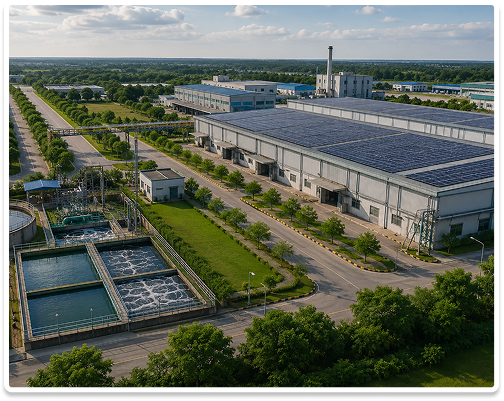
Textile manufacturing is among the most resource intensive industrial activities, making sustainability central to the success of PM MITRA Parks
PM MITRA Parks are designed to house the entire textile value chain from spinning and weaving to processing and garment manufacturing under one integrated umbrella. This concentration creates opportunities for shared sustainability interventions such as centralized effluent treatment, renewable energy, and industrial symbiosis. At the same time, the scale and interconnected infrastructure of textile processing create a strong case for shared responsibility where consistent compliance across every unit strengthens and protects the environmental standing of the entire cluster.
As global buyers increasingly demand traceable environmental and social compliance, and regulatory pressure on emissions, water use, and labour standards continues to intensify, structured sustainability frameworks are essential for these parks to remain competitive, attract investment, and retain access to global markets.
Textile manufacturing is water energy and chemical intensive and shared systems at the cluster level such as common effluent treatment plants mean that non compliance by a single unit can jeopardize the environmental standing of an entire park. As global buyers, particularly in the EU and North America, increasingly enforce supply chain due diligence requiring traceable sustainability compliance at the production-site level, PM MITRA Parks risk losing export competitiveness without a robust, measurable framework.
A dedicated textile specific approach to sustainability rather than reliance on generic industrial benchmarks is essential for these parks to remain globally competitive, attract sustained investment, and build long-term resilience against tightening environmental and regulatory expectations.
The framework was jointly developed by the Ministry of Textiles and the Asian Development Bank (ADB), with the objective of embedding sustainability into PM MITRA Parks from the ground up resulting in the first textile-sector-specific sustainability benchmarking system for Indian industrial parks.
Parameters were drawn from three established systems UNIDO's Eco-Industrial Park Framework, the Industrial Park Rating System, and the Digital Operations Maturity Assessment and adapted to the specific demands of textile production. These parameters were tested against the concept layouts and operational plans of PM MITRA Parks and benchmarked against five internationally recognized textile parks representing different models of sustainability integration, from centralized effluent governance in China to innovation-led circularity in Sweden. The findings were translated into a structured, four-pillar framework with defined and auditable scoring thresholds for each parameter.
The objective is to provide a structured, measurable, and auditable mechanism that allows each PM MITRA Park to be assessed where it stands today and what it must do to meet both national policy objectives and global sustainability expectations.
The framework is designed to move sustainability from a one-time assessment into ongoing governance. It will be embedded into project from initial stage with approval and monitoring processes, used during design review, construction milestones, and annual operational assessments.
Every score is backed by specified documentary evidence certified operational data photographs plans governance documents, and compliance records making the framework repeatable and defensible for ESG reporting and global buyer due diligence. As digital infrastructure such as IoT sensors, SCADA integration, and centralized dashboards through Integrated Command and Control Centres (ICCCs) is deployed, the framework will evolve from a periodic audit exercise into a live compliance and performance management system — signalling ESG readiness to global markets as India expands its share of textile exports.
The PM MITRA Sustainability Framework is a comprehensive, integrated assessment framework built by combining globally recognized sustainability principles from UNIDO's Eco-Industrial Park (EIP) Framework, IPRS 3.0, and the Digital Operations Maturity Assessment (DOMA), and contextualizing them to the unique requirements of India's integrated textile mega parks.
The framework is structured around four core pillars, namely Environmental Measures, Infrastructure & Monitoring, Social Measures, and Economic Performance, encompassing 13 indicators and 46 assessment parameters to evaluate sustainability, resilience, operational efficiency, inclusivity, and long-term economic competitiveness across PM MITRA Parks.
PM MITRA Sustainability Framework
Building sustainable textile ecosystems through responsible growth, efficient resource use, and environmental care.
Environment & Climate Resilience
Emission audits
Polluter Pays Principle
Monitoring authority
Industrial symbiosis/circularity
Biodiversity measures
Green Spaces
ESG Incentive Mechanism
Climate-related risks
Protection of Water bodies
Energy
Smart-metering of energy
Utilization of renewable energy sources
Green building certifications
Water
Sustainable measures for water supply
Facilities for rainwater harvesting
Smart-metering facilities for water with SCADA system integration
Stormwater drainage
Prohibition of the extraction of ground water
Groundwater recharge systems
Drip irrigation
Waste
Solid waste collection
Common Effluent Treatment Plant
Management of hazardous solid waste
Operational collection center for e-waste
Operating waste-to-energy projects
Monitoring
Integrated Command and Control Centre
Internal Infrastructure
Uninterrupted power
Internal roads
Transport modes
Built to Suit (BTS) or Plug & Play spaces
Employment Generation
Job Creation
Skills development
Local Business & SME Promotion
Local procurement
Specific area provided to MSMEs
Economic Value Creation
Annual tax contribution
Total industrial output
Social Infrastructure
Healthcare services
Education facilities
Skill development/training programs
Worker housing
Public transport linkage
Community facilities
Tenant Outreach & Dialogue
Tenant feedback
Grievance redressal mechanism
Labor Rights & Working Conditions
Compliance with International and national labor standards
Gender Equality
Female participation in the workforce
Gender-inclusive infrastructure